Perplexity & Burstiness: The Invisible Math Behind AI Detection (And How to Fix It)
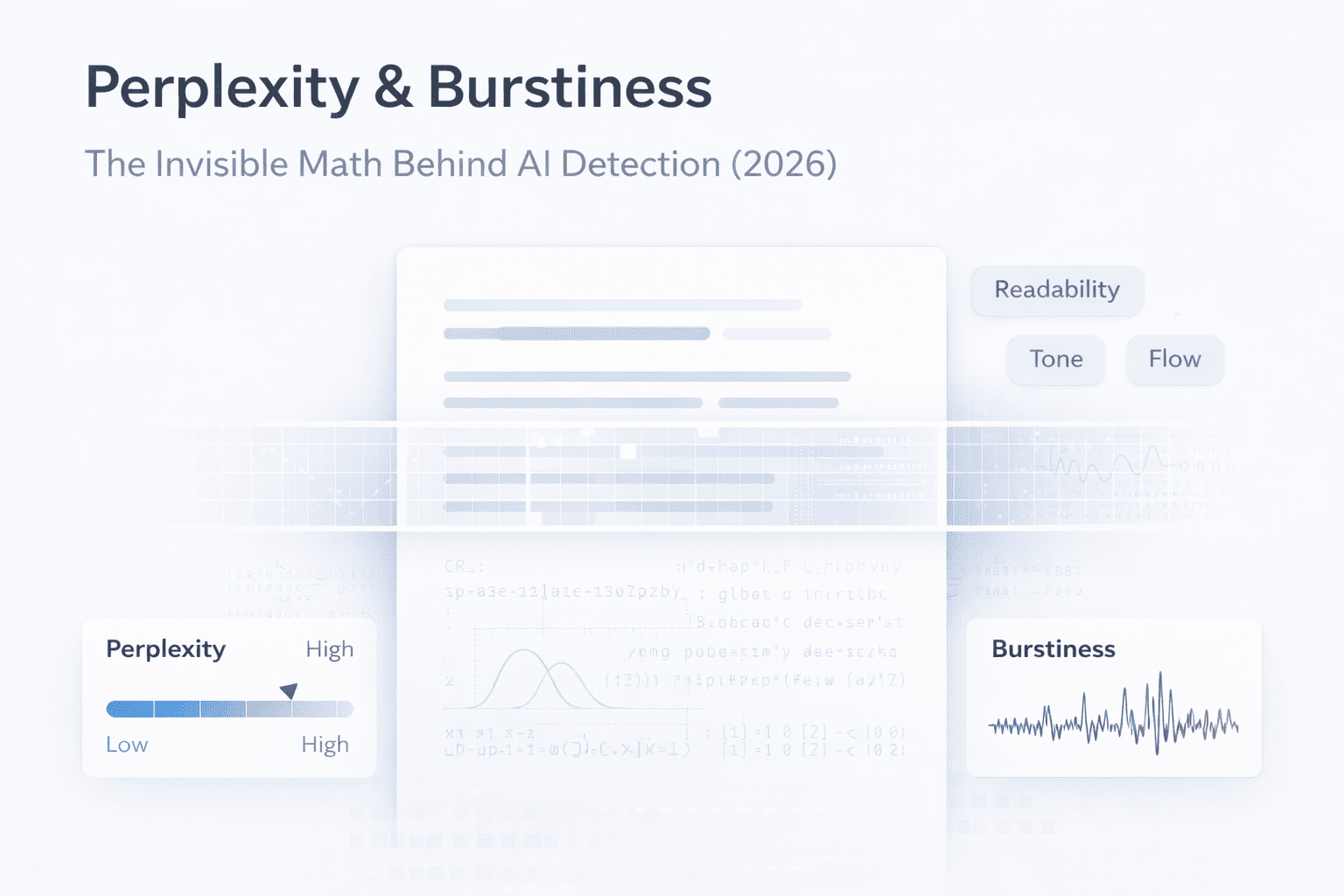
Perplexity & Burstiness: The Invisible Math Behind AI Detection (And How to Fix It)
Result: 95% AI-generated.
You didn’t cheat. But the algorithm thinks you did. Why? Because you accidentally wrote like a machine—and you didn’t even know machines had a “writing style.”
Here’s the truth: AI detectors aren’t reading your essay. They’re measuring it. And the two numbers that decide your fate are called perplexity and burstiness.
Let me show you the math that’s destroying your academic reputation.
The Digital Watermark You Can’t See
When ChatGPT writes a sentence, it’s not “thinking.” It’s calculating probabilities. Every word is chosen because it’s the most statistically likely next word based on billions of text samples.
Translation: AI writes in patterns. Predictable, mathematical patterns.
Human writers? We’re messy. We contradict ourselves. We use words because they feel right, not because they’re statistically optimal. That messiness is what GPTZero and Turnitin are hunting for—or rather, hunting for the lack of it.
Think of AI-generated text as a watermark embedded in the math itself. You can’t see it, but detection software can. And if your natural writing happens to align with those patterns? You’re guilty until proven innocent.
Perplexity: The “Surprise Me” Score
Definition: Perplexity measures how unexpected your word choices are to a language model.
Low perplexity = predictable = AI-like.
High perplexity = surprising = human-like.
If ChatGPT can easily predict your next word, your perplexity score tanks. And that’s a red flag.
The Side-by-Side Test
Let’s compare two sentences saying the same thing:
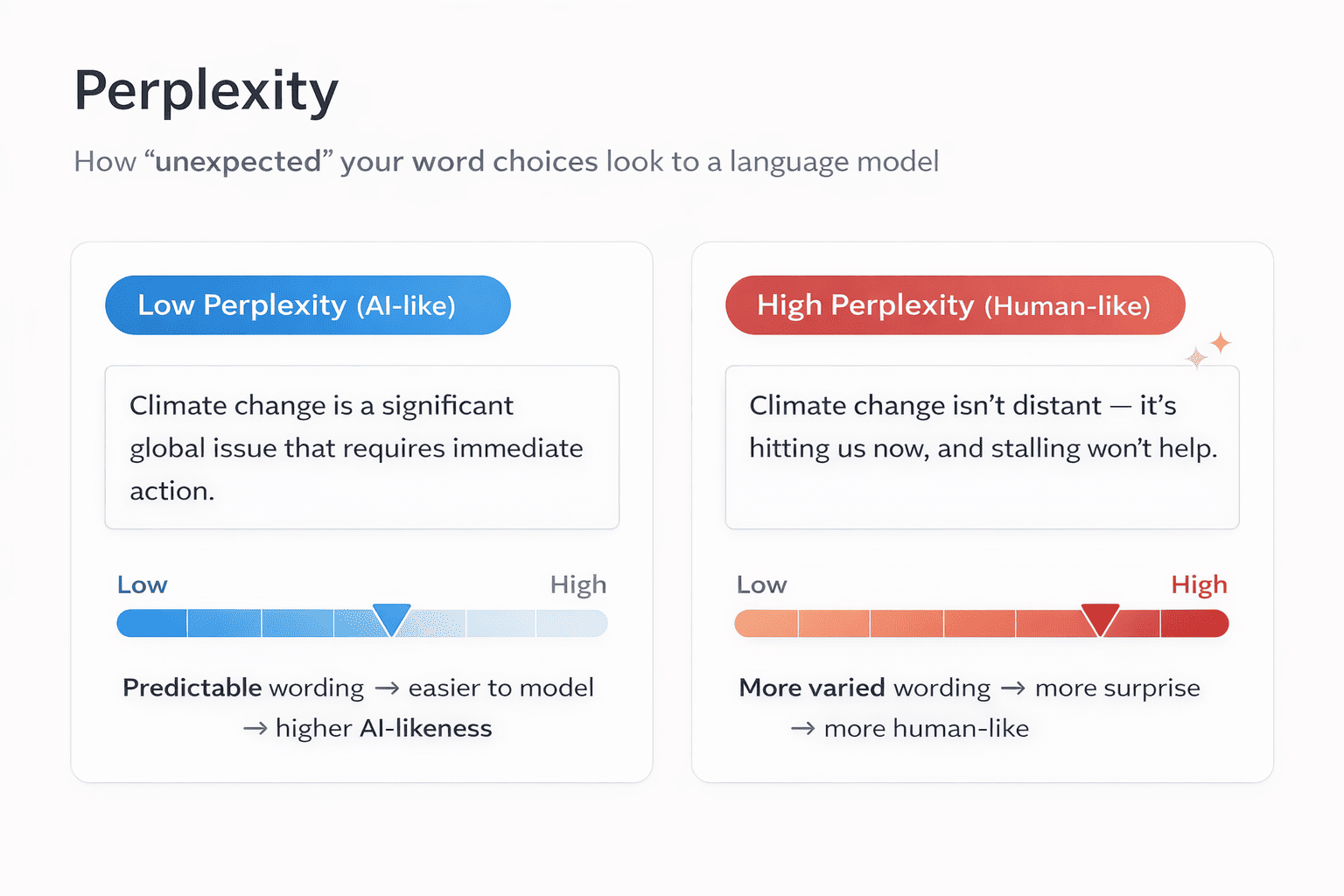
Low Perplexity (AI-Like): “Climate change is a significant global issue that requires immediate action from governments and individuals alike.”
Analysis: Every word here is the “safe” choice. “Significant,” “global,” “requires,” “immediate”—these are the exact words an AI would pick because they appear together constantly in training data. Zero surprises.
High Perplexity (Human-Like): “Climate change isn’t just some distant threat—it’s hammering coastlines right now, and if we keep stalling, we’re cooked.”
Analysis: “Hammering”? “Cooked”? These are unexpected verb choices. The contraction “isn’t” and the casual “right now” add linguistic chaos. A human took a risk here. An AI wouldn’t.
The brutal irony? If you’re a strong academic writer who uses formal vocabulary correctly, you’re more likely to get flagged. You’ve trained yourself to write clearly and concisely—which is exactly how AI writes.
Burstiness: The Rhythm Your Teacher Hears
Definition: Burstiness measures the variation in your sentence structure—how much your sentence lengths and complexity bounce around.
Picture two graphs:
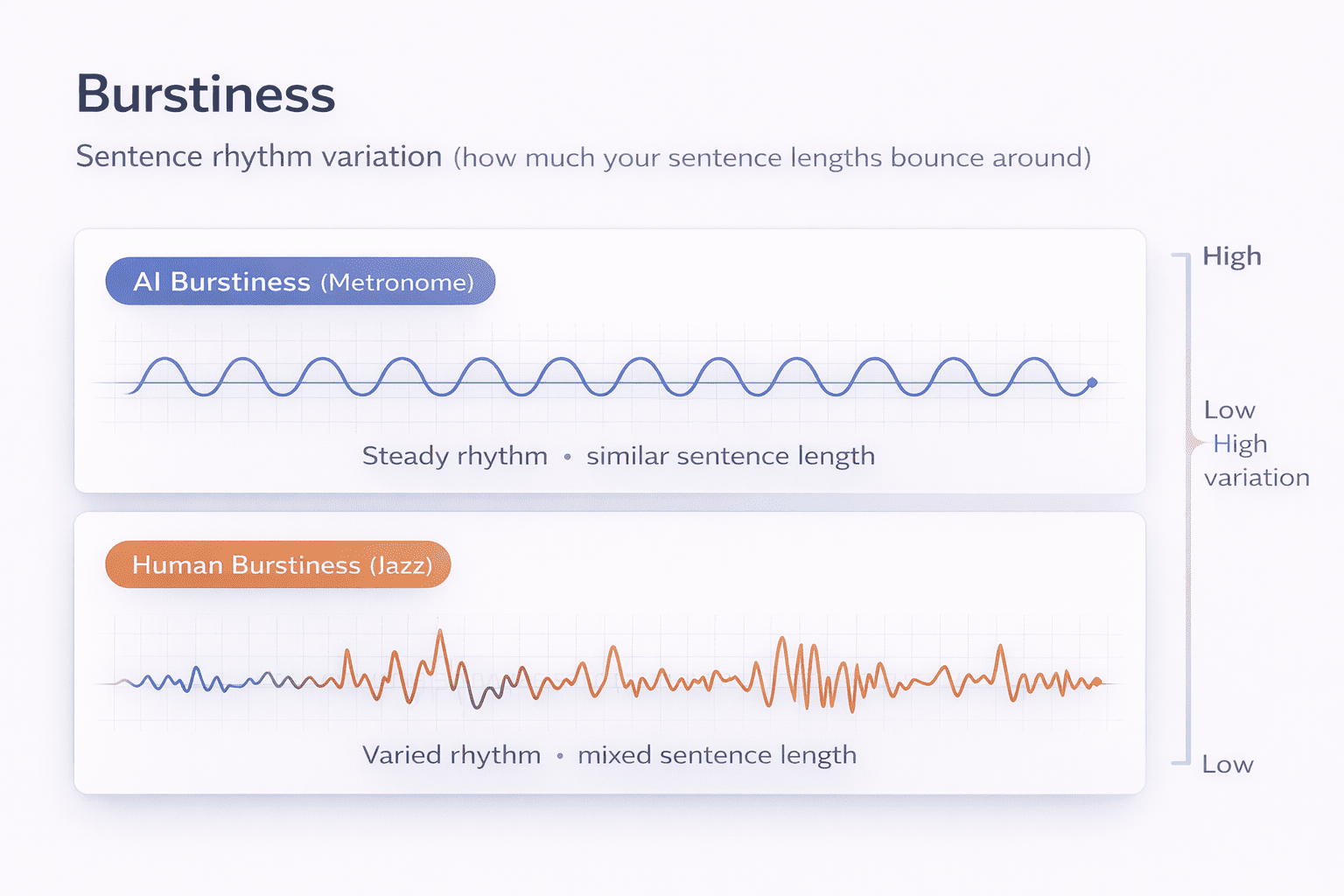
AI writing: A flat line. Every sentence is 15-20 words. Every paragraph has the same structure. It’s the literary equivalent of a metronome.
Human writing: A seismograph during an earthquake. Short punch. Then a long, winding sentence that builds momentum and circles back to reinforce the point with a dependent clause. Then another short one.
Detectors literally plot your sentence lengths on a graph. If it’s too smooth, you’re flagged.
The Jazz Analogy (Sharpened)
AI writes like a drum machine: perfect 4/4 time, every beat identical, no dynamics.
Humans write like jazz: a sudden saxophone riff (short, punchy sentence), then a slow bass solo (long, exploratory thought), then chaos—everyone improvising at once.
Your burstiness score measures how much you “improvise.” And if your essay reads like a metronome? The algorithm assumes a machine wrote it.
The Problem: You Can’t Fake Randomness on Command
Now you know the secret. Just write with more perplexity and burstiness, right?
Wrong.
Try this exercise: Write a paragraph where every sentence is a different length, and use unexpected word choices—but make sure it still sounds natural and stays on topic.
Exhausting, isn’t it? You’re forcing your brain to be a randomness generator while simultaneously organizing coherent arguments. It’s like juggling while doing calculus.
Even if you succeed, there’s no guarantee. You’re guessing at what “high enough” perplexity looks like. You don’t have the detector’s algorithm. You’re shadow-boxing.
And here’s the kicker: Over-editing your own work to “sound human” often makes it worse. You second-guess natural phrasing. You add awkward synonyms. You break rhythm trying to force rhythm.
The Smarter Solution: Let Math Fight Math
If AI detectors use algorithms to measure your text, you need an algorithm to rewrite your text—one that specifically targets perplexity and burstiness scores.
Enter tools like Humanize ChatGPT.
Think of it as an NLP scrambler—not a paraphrasing tool, but a mathematical countermeasure. Here’s what it actually does under the hood:
- ✅ Injects lexical diversity: Swaps predictable word choices for synonyms with lower co-occurrence rates in training data (raising perplexity).
- ✅ Varies syntactic structure: Breaks monotonous sentence patterns by alternating simple, compound, and complex structures (boosting burstiness).
- ✅ Adds micro-imperfections: Introduces minor stylistic “flaws” that humans naturally produce—like starting sentences with conjunctions or using informal contractions.
It’s not about “tricking” the detector. It’s about mathematically adjusting your text to match human writing patterns.
Does it work on content you wrote yourself? Absolutely. If your natural style happens to be low-perplexity (clear, formal, academic), running it through a humanizer recalibrates those metrics without changing your core ideas.
FAQ: The Questions You’re Already Asking
If I use Grammarly or ProWritingAid, will that hurt my score?
Possibly. Grammar checkers optimize for “correctness,” which often means choosing the most common phrasing—exactly what AI does. If you apply every suggestion blindly, you’re lowering your perplexity. Use grammar tools, but don’t let them steamroll your voice.
Can AI detectors be flat-out wrong?
Yes. Studies show false positive rates between 10-30%, especially for non-native English speakers and STEM students (technical writing is inherently low-perplexity). Detectors are probabilistic, not omniscient.
The Bottom Line
You’re not fighting a teacher. You’re fighting a statistical model that’s guessing based on word choice and sentence rhythm.
Manual editing won’t save you—because you can’t see the metrics the detector sees. You’re editing blind.
But tools built specifically to adjust perplexity and burstiness? They speak the same mathematical language as the detectors. And in that fight, you need to bring the right weapon.
Your choice: Spend hours second-guessing every sentence, or let an algorithm rebalance the math in 30 seconds.
The detectors already made their choice. Now you make yours.
Humanize My Text Free →